
































Specification · 22 September 2026 · 5 min read
Specifying a rug for a project: what belongs in the schedule
A rug arrives at the end of a project, when there is no time left to fix it. Everything that prevents that is decided at the beginning, and most of it fits on one page.
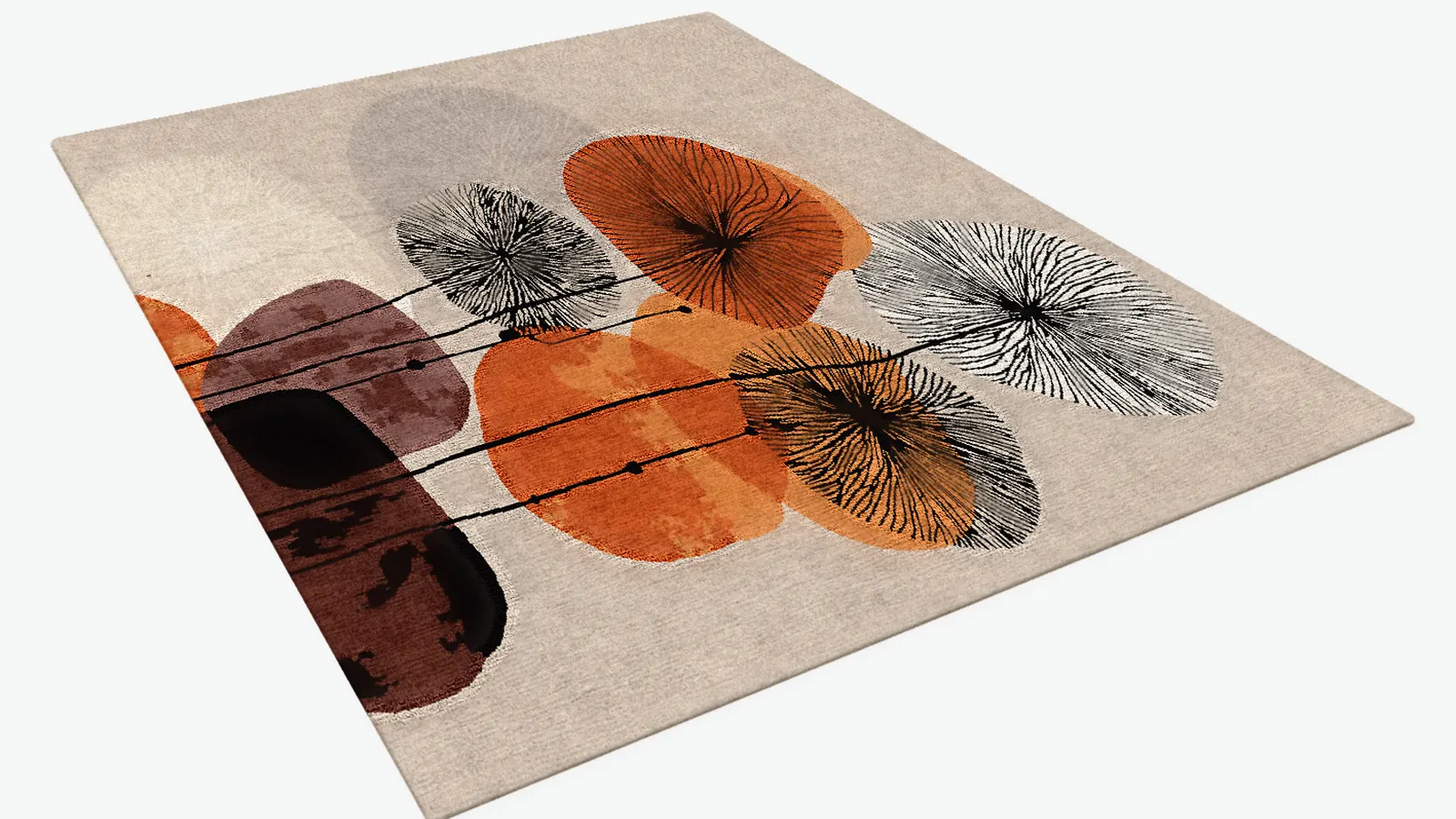
This is written for the person who has to put a bespoke rug into a room schedule and then answer for it. It is the checklist we would want to receive, and the questions we would want asked of us before an order is placed. Nothing here is specific to this atelier except where it says so.
What to state
- Finished size in millimetres, and the shape. Any shape can be woven; a free outline needs a drawing, not a description.
- Construction: hand-knotted, hand-tufted or flatweave, and the knot density if it is knotted.
- Pile height. Ours is 12 to 14 millimetres as standard; a different height is a specification, not a preference.
- Fibre, per colour, not per rug.
- Colour, as a register code per zone.
- Edge and finish: selvedge, fringe or no fringe, and which end if the design has a direction.
- The date the rug has to be in the room, which is not the date it leaves the loom.
What to agree in writing
Three things cause almost every dispute in handmade goods, and all three are cheap to settle beforehand.
- Dimensional tolerance. A handmade rug is woven by hand on a stretched warp and comes off the loom close to, not exactly at, the drawing. Ask for the tolerance in writing and record it.
- Colour approval. Name the physical reference that governs, whether pom or knotted swatch, and who signed it and when. A render is not that reference.
- Matched pieces. If two rugs must agree with each other, say so in the order so they are dyed and woven together.
Time
Our standard editions ship six to eight weeks after payment. A bespoke commission is twelve to sixteen weeks from an approved render, and the clock starts at the approval rather than at the brief, which is where project programmes usually go wrong. Add one to two weeks for delivery inside Europe, and longer outside it.
A hand-knotted swatch, if the project wants one, is a further two to three weeks and has to happen before the sixteen weeks begin, not during them. Draw the programme backwards from the installation date and the approval deadline appears on its own.
The programme, worked backwards
For a commission that has to be on the floor on a fixed date, count back: one to two weeks for delivery inside Europe, twelve to sixteen weeks at the loom and in finishing, two to three weeks for a knotted swatch if the project wants one, and a fortnight of drawing and revision before that. Five months before handover is not early for a bespoke rug; it is the normal start.
The two dates that matter in the programme are the render approval and the colour approval. Every week either of them slips, the delivery slips with it, because nothing behind them can start.
Money
Bespoke commissions are billed 30 per cent on order confirmation and 70 per cent on completion. Standard editions are paid in full at order. Above CHF 20’000 an interest-free three-instalment plan can be arranged on request. Custom sizing moves the price in proportion to surface area, so a size change during design is a price change and should be re-approved.
Delivery and access
Across mainland Europe and the United Kingdom, two-person white-glove delivery is included: the team arrives in an agreed two-hour window, carries the rolled rug to the room, removes all packaging and places it. Worldwide shipping is quoted per piece.
What the schedule should carry is the access, because a rolled rug is a rigid object. State the stair width and the turns, whether there is a lift and its internal depth, and the parking or loading arrangement. A four-metre roll that cannot turn a landing is a problem discovered on the day, and it is entirely preventable on paper.
The floor under it
- Underlay. A pile rug on a hard floor wants one for grip and wear; a flatweave needs one.
- Door clearance. Measure the swing against the pile height plus the underlay.
- Underfloor heating. Wool is compatible with it; keep the floor surface temperature moderate and expect a rug to slow the heat-up of the room it covers.
- Light. Plant dyes deepen and soften with time; direct sun accelerates and flattens that. A sheer blind or a UV film is the usual answer.
Questions worth asking any supplier
- Where is it woven, and by whom? A supplier who cannot answer this in one sentence is a reseller, which may be fine, but it changes who is accountable when something is wrong.
- What is the dimensional tolerance, in millimetres?
- What physical reference governs the colour, and who signs it off?
- If it is tufted, what backing and what adhesive, and what is the expectation of its life?
- What happens if the rug is damaged in year three? Ask specifically whether they repair what they sell.
What to keep on file
At handover, the file should hold the approved render, the register codes, the fibre per colour, the construction and knot density, the finished size as measured, the care card, and the delivery note. That is everything a future cleaner, insurer or owner needs, and it takes one page.
Carpet Artisan is based in Zurich, and the rugs are made to order by women artisans in Afghanistan, Armenia, India and Tibet. For project work there is a trade programme, and the atelier will work directly with an architect or designer on a commission.