



















Placement · 22 September 2026 · 5 min read
Size and placement: the measurements that decide a room
Most rugs in most rooms are too small, and it is almost always the same mistake. The measurements below are the ones our clients and their architects work to.
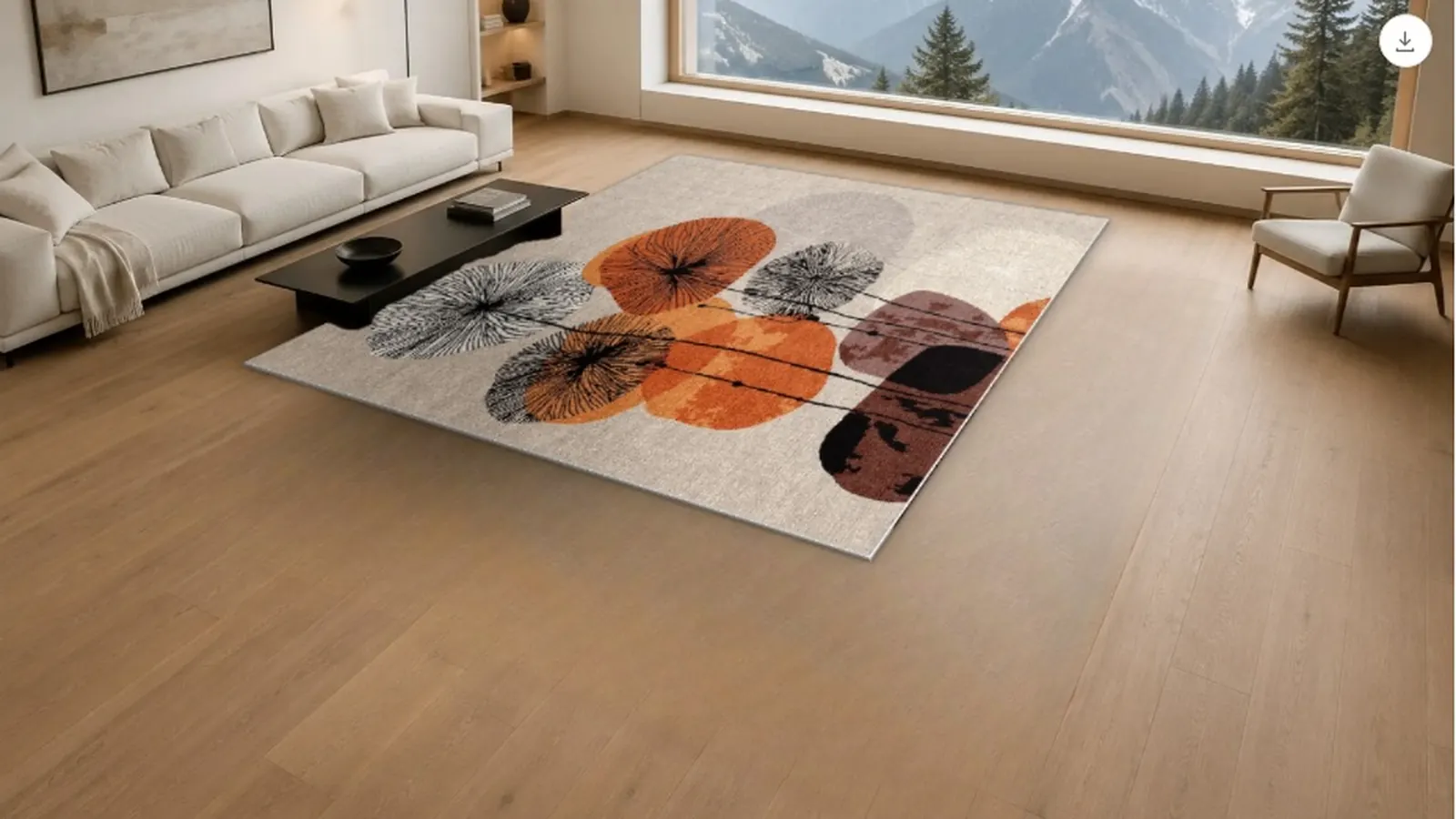
A rug does one architectural job: it draws a room inside the room. Get the size right and the furniture reads as one group standing on something. Get it wrong and the rug reads as an object marooned in the middle of the floor. The rules below are conventions rather than laws, but they are the conventions that make rooms look composed, and they are stated here in centimetres because that is what a Swiss plan is drawn in.
Living rooms
Work from the seating, never from the room. There are three defensible arrangements:
- Everything on. Every leg of every piece sits on the rug, with roughly 20 centimetres of rug beyond the outermost legs. It is the most generous and the most expensive, and it is what a large room wants.
- Front legs on. The front legs of the sofa and the chairs stand on the rug, the back legs on the floor. It ties the group together at a smaller size and is the most common arrangement in a normal room.
- Nothing on, one island. Only the table stands on the rug, with the seating around it on the floor. This works only when the rug is large enough to sit under the whole conversation, and it fails as soon as it is not.
Two further numbers hold it together. Leave 15 to 45 centimetres of bare floor between the rug and the wall, so the rug reads as an inset rather than as a failed fitted carpet; and where people walk past the group, keep a path of 60 to 90 centimetres.
Dining rooms
One measurement decides this room. A dining chair travels about 60 centimetres backwards when someone stands up, and the rug has to still be under its back legs when it does, or every meal ends with chairs catching on an edge. Allow 90 centimetres of rug beyond the table on all four sides and the problem never occurs.
For a 200 by 100 centimetre table that gives a rug of about 380 by 280 centimetres. For a round table of 140 centimetres, a round rug of about 320. These are not standard sizes in any catalogue, which is precisely the argument for having the rug made.
Bedrooms
The test is where your feet land. Three arrangements work:
- Under the bed and out, with 60 to 80 centimetres of rug showing on both sides and at the foot. Start the rug below the bedside tables rather than under them.
- Across the foot of the bed, for a smaller room or a second rug.
- A runner on each side, 70 to 90 centimetres wide, which suits a room with a fitted wall or a low bed.
Halls, stairs and kitchens
A runner wants 10 to 15 centimetres of floor showing on each side, so measure the corridor and subtract 20 to 30. Keep it at least 15 centimetres short of the door swing at each end. In a kitchen, the runner belongs along the working side of the island, and at a low pile: a deep pile in front of an oven is a cleaning problem with a decorative appearance.
Round, irregular and layered
A round rug wants a reason: a round table, a circular lantern above it, a square room that needs its corners softened. Size it the same way as a rectangle, from the furniture outward, and remember that a round rug in a rectangular room leaves four corners of floor that have to look deliberate.
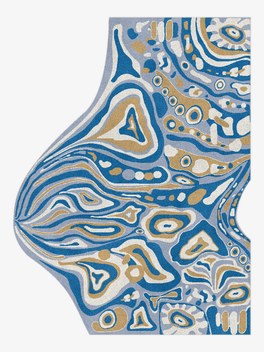
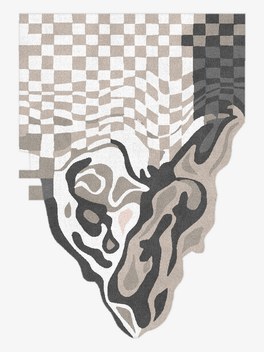
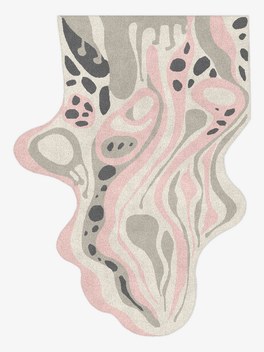
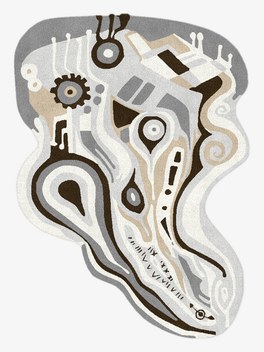
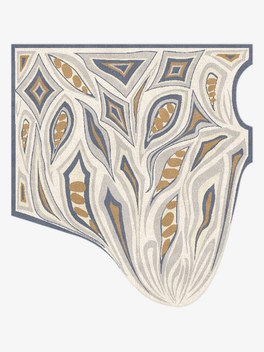
An irregular outline is a different instrument. It reads as an object rather than a zone, so it suits a space where there is nothing to align to: a reading corner, a bedroom foot, a wide landing. Since every outline here is cut from its own drawing, the shape is a design decision rather than a catalogue choice.
Layering a small rug over a large flat one is the oldest trick in the trade for a room that needs both warmth and a defined centre, and it works best when the two differ clearly in pile and in scale of pattern rather than slightly.
A rug on a carpet
It is allowed, and it is common in Swiss apartments with fitted wool carpet. Two conditions: the rug should be noticeably denser or deeper than the carpet under it, or it will read as a patch; and it needs an underlay made for carpet-on-carpet, because a rug that creeps across a soft floor will also ruck.
How to be sure before you order
Tape the outline on the floor at full size, in painter’s tape, and live with it for two days. Walk the paths, pull the chairs out, open the doors. It takes ten minutes and it is the only method we know that catches a wrong size before it is woven.
Then check the things that are easy to forget: the clearance under a door that swings over the rug, the depth a rug and its underlay add at a threshold, and the access for delivery, since a rolled four-metre rug does not turn a tight stair.
Why standard sizes exist at all
Standard sizes are a manufacturing and warehousing convenience. They exist so a shop can hold stock, and they have no relationship to your room. Every design here is knotted to order, in any size and any shape, and the price follows the surface area rather than a size bracket, so a rug that is 15 centimetres wider than a standard costs 15 centimetres more and not a size band more.
If you send the room dimensions, the furniture layout and where the light comes from, the atelier will come back with a size and a shape and the reasoning for both. We answer within one working day.