


Construction · 22 September 2026 · 6 min read
Hand-knotted, hand-tufted, flatweave: what the three constructions change
The same drawing, the same wool and the same dyes will give you three different rugs, three different prices and three different lifespans. The construction is the decision underneath every other one.
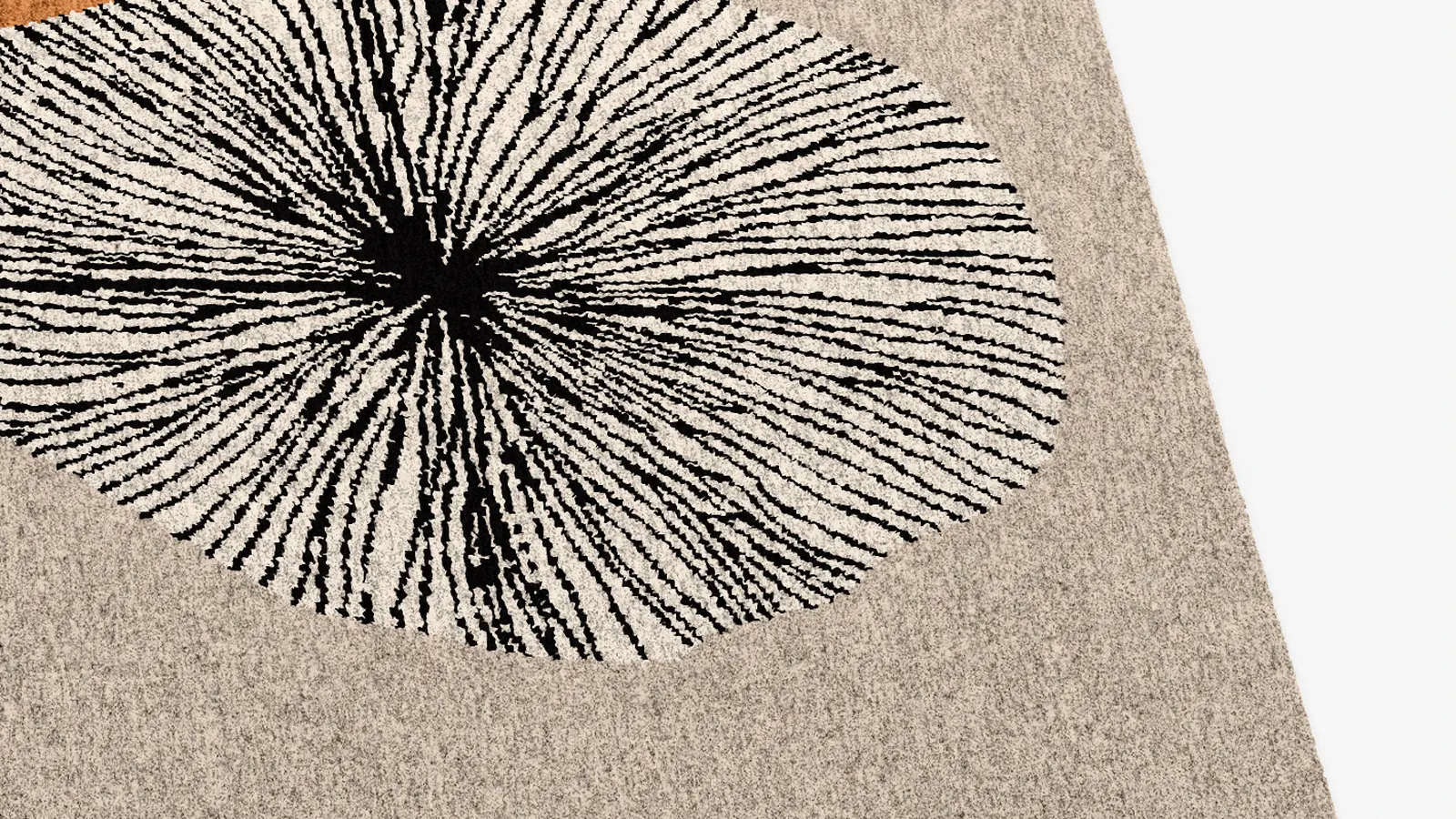
Every rug on this site can be ordered hand-knotted, hand-tufted or flatweave. The choice is made early, because it changes what the drawing can hold, what the floor feels like, what the rug costs and how long it lasts. This is what separates the three, in the order the decision usually gets made.
How each one is made
A hand-knotted rug is built knot by knot on a vertical loom. A weaver ties a length of yarn around pairs of warp threads, row after row, and beats each row down before starting the next. The pattern is not applied to the rug: the pattern is the rug, because every knot is a pixel of it. Nothing holds the rug together but the weaving itself.
A hand-tufted rug is made by punching yarn through a stretched canvas with a hand-held tufting tool. The loops are then sheared to an even height, and the back is coated with an adhesive and closed with a second cloth, which is what keeps the tufts in place. The tool follows the drawing freehand, so the work is faster by an order of magnitude.
A flatweave has no pile at all. Weft threads pass over and under the warp and the pattern is made by the interlacing itself, which is why a flatweave usually reads the same on both faces and lies thin enough to sit under a door.
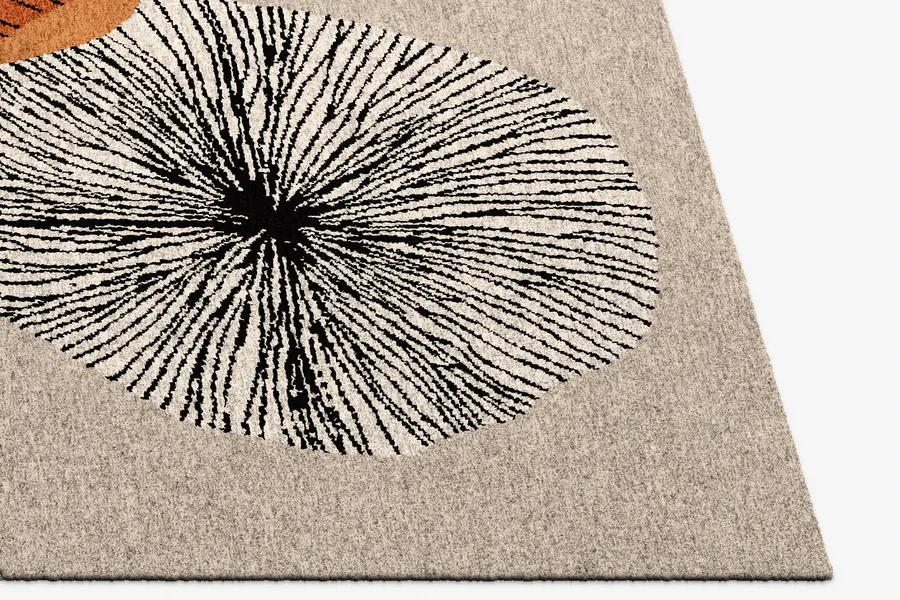
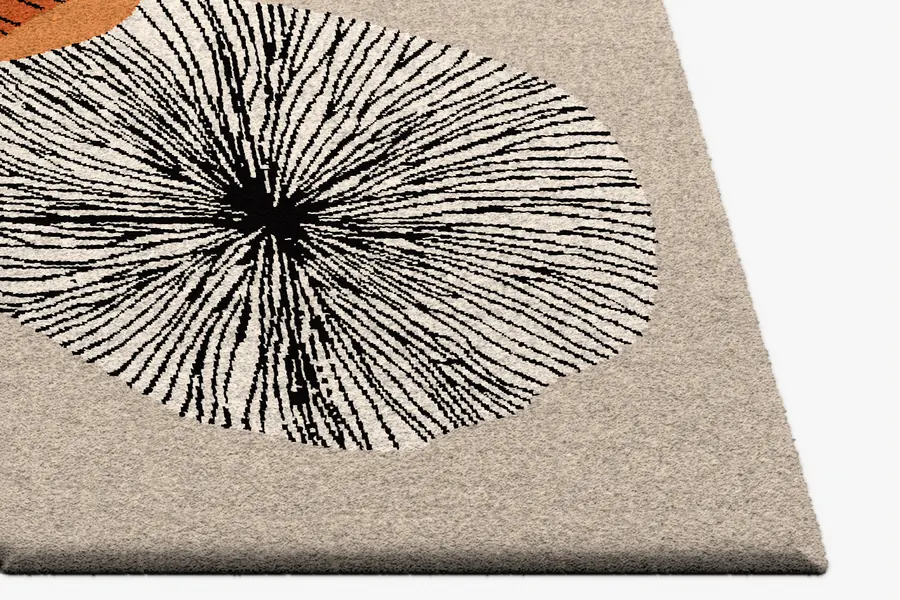
The back tells you which one you own
Turn a rug over and the construction is obvious in a second. On a hand-knotted rug the pattern is legible on the reverse, knot by knot, because there is nothing between you and the weaving. On a hand-tufted rug the reverse is a plain backing cloth: the pattern is sealed behind it.
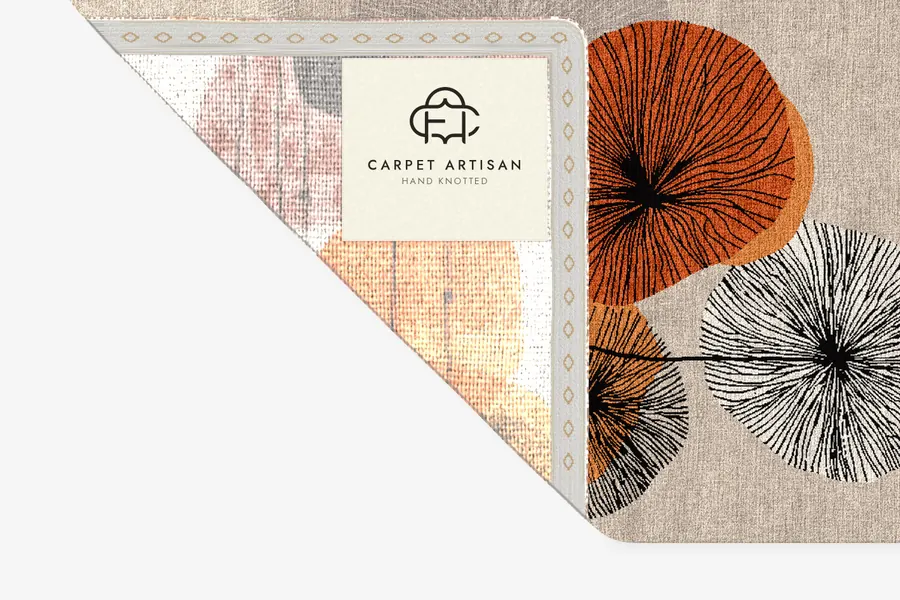
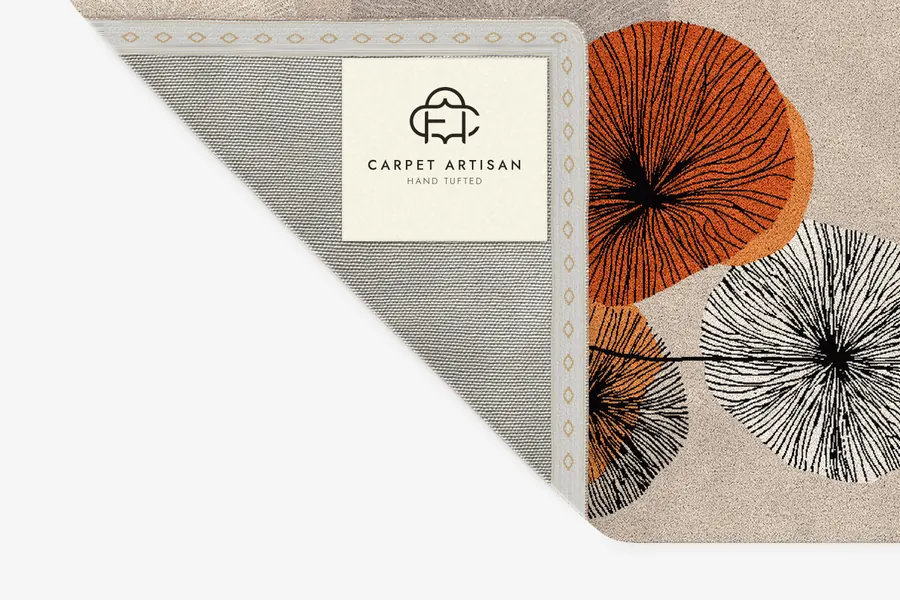
This is the single most useful test a client can apply in a showroom, and it is worth knowing before a purchase rather than after one.
Knot density, and what it actually buys
Knot density is counted in knots per square inch. On our standard editions it is set at 100, 150 or 200 knots; finer counts, up to 400 on fine silk pieces, are a commission question and carry a proportionally longer time at the loom.
Density is not a quality score. It is resolution. A high count lets the drawing hold a curve, a thin line or a small character without the weave stepping it; a low count suits broad fields and large geometry, and gives a coarser, softer surface that many designs are better for. Doubling the count roughly doubles the knots to be tied, which is why it moves the price and the lead time and not much else.
| Hand-knotted | Hand-tufted | Flatweave | |
|---|---|---|---|
| Made by | Knots tied on a loom | Yarn punched through a canvas | Weft woven through warp |
| Pile | 12 to 14 mm as standard | Sheared to a set height | None |
| Pattern resolution | Set by knot density | Drawn freehand by the tool | Set by the weave |
| Reverse | The pattern reads through | A backing cloth | The same as the face |
| Time at the loom | Months | Days to weeks | Weeks |
| Repairable | Yes, knot by knot | Limited, the backing ages | Yes, rewoven |
| Typical use | The rug you keep | Budget or a short interior | Thin, reversible, layered |
What a knot actually is
Two knots carry nearly all the hand-knotted rugs in the world. The Persian, or asymmetric, knot wraps one warp thread fully and passes behind the next, and it lets a design hold fine curves. The Turkish, or symmetric, knot wraps both warps and gives a sturdier, squarer pile. The Tibetan knot works differently again: the yarn is looped around a rod laid across the warps, and the loops are cut when the rod is pulled out, which is what gives Tibetan weaving its even, springy surface and its speed.
None of the three is better than the others in the abstract. They suit different drawings, and they are the traditions of different places, which is why the rug you are looking at was knotted the way it was.
How each one ages
A hand-knotted rug has no part that fails before the wool does. It can be rewoven at an edge, refringed, reknotted where it has been burnt or cut, and washed by hand many times over its life. The trade routinely quotes fifty years and more for one that is looked after, and the antique market is the evidence: the rugs being bought and sold at a hundred years old are knotted rugs.
A hand-tufted rug is held together by its adhesive layer, and that layer, not the wool, sets the clock. As it hardens the rug sheds more and the backing can separate, and the trade commonly quotes something between five and twenty years depending on traffic. That is not a reason to avoid one. It is a reason to put one where a shorter life is the honest expectation: a rental interior, a room that will be redecorated, a large surface on a fixed budget.
A flatweave has no pile to crush, so it does not show a traffic path the way a pile rug does. What it does instead is move: without weight and pile to hold it, a flatweave needs an underlay on a smooth floor.
What each one costs, in the only terms that matter
Price follows labour, not materials. A hand-knotted rug is months of one person’s work, and that is most of what you pay for; the same drawing hand-tufted is a fraction of the time and lands at a fraction of the price. Our standard editions ship six to eight weeks after payment, a bespoke commission twelve to sixteen weeks from an approved render, and the difference between those two numbers is mostly the drawing and the dyeing, not the weaving.
The useful comparison is not price against price but price against years. A knotted rug at three times the price of a tufted one, kept three times as long and worth something at the end of it, is the cheaper floor.
Three questions that settle it
When a client cannot decide, these three usually do it for them.
- How long will this room stay as it is? Under five years, a tufted rug is a rational choice. Longer than that, or if the rug should outlast the room, it is knotted.
- What is the traffic? A path that is walked several times a day wears the surface, and the surface that survives it is a knotted pile at a moderate height.
- Is the drawing detailed? Fine line work, small characters and tight curves need knot density, and knot density means knotted. A broad field of two or three colours does not.
Choosing, room by room
- A living room that will not be redecorated soon: hand-knotted, and size it generously.
- A dining room: hand-knotted or flatweave. Chairs are dragged, and a tufted surface wears fastest exactly where the chairs are.
- A bedroom: any of the three. Traffic is low, so this is where a tufted rug lasts longest and where a deep pile is most worth having.
- A hall or a staircase landing: hand-knotted, at a low pile.
- A terrace or a veranda: our outdoor construction, woven flat in a recycled yarn.
Every design in the collection shows all three constructions on its own page: the close-up, the side and the reverse are rendered for each, from the same drawing, so the difference can be seen before anything is ordered.